


















HCA Healthcare, Inc. is a major hospital and healthcare services operator with over 50,000 beds across its facilities and a workforce of more than 30,000 employees. HCA Healthcare reported revenues for the year ended December 31, 2024, totaled $70.603 billion, compared to $64.968 billion for the year ended December 31, 2023. And adjusted EBITDA totaled $13.882 billion in 2024.
The company has made several substantial investments in AI through strategic partnerships and technological innovation. The company collaborated with Google Cloud to implement generative AI for clinical documentation and to improve patient care.
Additionally, it also partnered with Commure, following Commure’s acquisition of ambient AI pioneer Augmedix, to deploy an ambient AI platform that enhances physician productivity and clinical workflows across its network of 188 hospitals and approximately 2,400 sites of care.
This article explores two business AI use cases at HCA that give direct perspective on the place these capabilities hold in larger enterprise strategy and core business goals:
- Improving workflow efficiency by automating documentation: Implementing medically-tuned generative AI to automate clinical documentation that frees clinicians’ time and enhances handoff consistency.
- Strengthening perinatal outcomes by centralizing real-time maternal data: Integrating advanced AI and predictive analytics in real-time perinatal care to unify maternal and fetal data to detect risks earlier and reduce cognitive load for healthcare professionals.
Improving Workflow Efficiency by Automating Documentation
U.S. physicians face substantial documentation burdens, particularly around electronic health record (EHR) documentation. A 2022 JAMA Internal Medicine study found that 58.2% of office-based physicians felt their documentation time was not appropriate and that it reduced the time they had with patients.
Documentation inefficiencies reduce the time physicians can spend with patients, and prior research links such burdens to clinician burnout. Against this backdrop, many health systems are exploring generative AI tools to streamline documentation and free up more time for direct patient care.
As per a press release published by HCA, the company partnered with Google Cloud to address the above challenges by deploying generative AI to improve clinical workflows and reduce time-consuming documentation. The same document shares that starting in early 2023, about 75 emergency room physicians at four HCA hospitals piloted Google’s AI tools to quickly and accurately document key medical information from conversations during patient visits.
The collaboration also included Augmedix, whose ambient medical documentation capabilities were integrated with Google Cloud’s medically tuned large language model, Med-PaLM 2. The system operates within Google Cloud’s HIPAA-compliant infrastructure, ensuring that patient data is processed securely within HCA Healthcare’s environment.
The above-cited press release shares that previously, nurses had to verbally relay or manually compile information on medications, labs, vital signs, patient concerns, and treatment responses during each shift change. With the new Google Cloud LLM–powered tool with custom prompts, the system automatically generates clear, intuitive handoff reports directly from EHR data.
In the new workflow, nurses at beta sites like UCF Lake Nona Hospital receive AI-generated drafts for quick review and approval, helping them save time while ensuring greater continuity, safety, and consistency through human oversight.
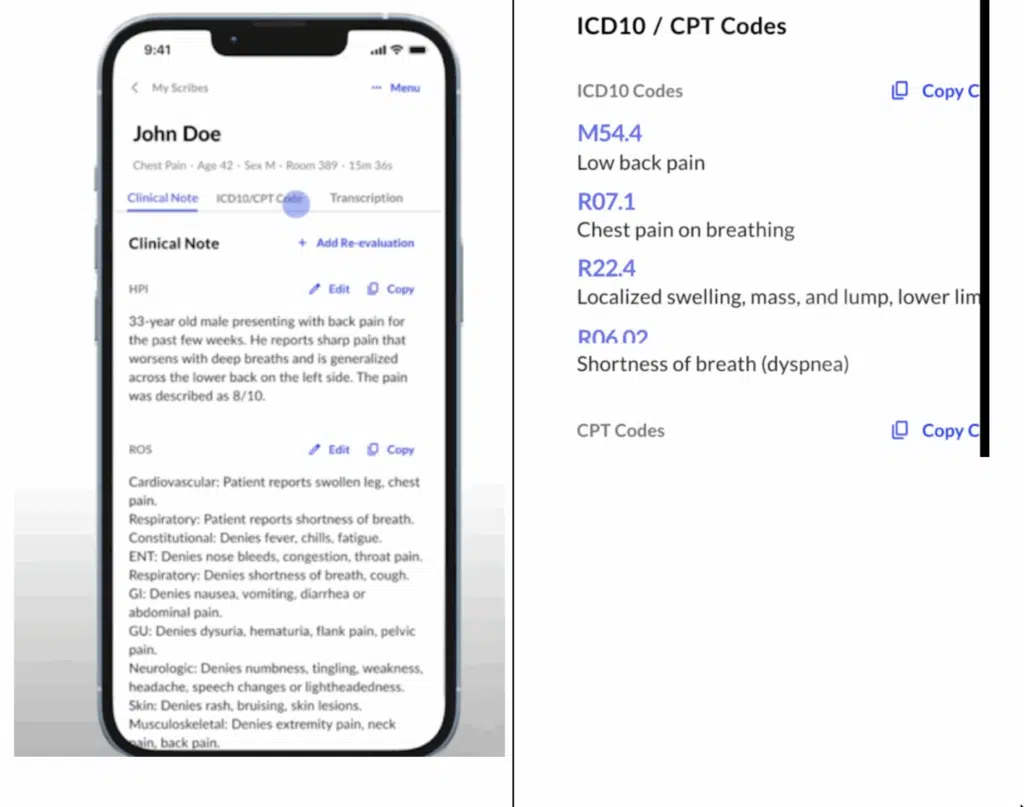
Screenshots from Commure’s Ambient solution showing how nurse–patient conversations are automatically captured and coded for accurate documentation. (Source: Commure)
According to Commure’s website, their platform, also branded and trademarked as Ambient AI (though not to be confused with ambient AI as a category descriptor of technology that describes their product), helps clinicians and nurses in various ways:
- Captures natural patient-clinician conversations supporting 60+ languages, accents, dialects
- Employs Natural Language Processing and fine-tuned Large Language Models to draft structured medical notes from transcribed conversations
- Automatically generates CPT codes, ICD-10s, modifiers, and quality measures from documentation, reducing admin work while allowing staff review
- Allows intuitive editing, one-click upload to EHR, bi-directional integration, and mobile/web access to minimize time in electronic health records
No publicly available data provides direct, quantified business results specifically tied to HCA Healthcare’s 2023 Google Cloud generative AI pilot, such as precise cost savings, time reductions, or ROI metrics. The original press release notes that measurement data were collected during the pilot, with only qualitative feedback such as “strong physician satisfaction” reported, and no follow-up numbers have been disclosed in earnings calls, investor reports, or updates through 2025.
However, HCA’s broader financials show strong growth post-pilot — e.g., Q3 2025 revenues up 9.6% to $19.161 billion and net income up 29.4% to $1.643 billion. Yet the company has still not explicitly attributed this increase to AI or automation.
Strengthening Perinatal Outcomes by Centralizing Real-Time Maternal Data
With the maternal mortality rate in the United States worsening in recent years, hospitals are facing significant challenges in perinatal care. According to a 2025 JAMA Network Open study and a 2025 NIH study, the U.S. maternal mortality rate increased by 27% from 2018 to 2022, reaching 32.6 deaths per 100,000 live births.
While the 2025 JAMA Network Open study does not examine causes of the rise, the increasing pregnancy-related mortality rate underscores why many hospitals are prioritizing more proactive approaches to monitoring maternal health risks.
According to a press release from GE HealthCare, HCA Healthcare partnered with the GE subsidiary to co-develop CareIntellect for Perinatal, a cloud-based platform designed to improve perinatal care by addressing critical clinical workflow challenges through AI-driven insights.
The partnership aimed to create a cloud-first software solution that integrates seamlessly into clinicians’ daily workflows, delivering real-time, actionable insights directly at the point of care. The software’s cloud functionality was intended to help clinicians focus on patient care, improve maternal and fetal outcomes, and reduce the cognitive burden of managing complex data from multiple sources.
CareIntellect claims to integrate AI and predictive analytics via GE HealthCare’s infrastructure to provide:
- Single chronological dashboard for real-time monitoring
- Event annotation
- Historical data access, and
- Remote patient oversight.
A promotional video from GE Healthcare notes that before this technology, clinicians had to manually hunt across disparate systems for relevant maternal and fetal data, a time-consuming process that increased the risk of missing crucial insights.
During the launch of CareIntelliect, Jeff Carron, Chief Digital and Technology Officer, Patient Care Solutions at GE, said in an interview depicted in the video above that “there is a ton of load on the systems. It is stopping clinicians or the care teams’ ability to spend valuable time with the patients and the families during the labour event.”
CareIntellect also claims to transform this by aggregating real-time data into a clear, connected dashboard that supports intelligent clinical decision-making at the bedside. These functions enable care teams to detect risks such as preterm labor or hypertension promptly and focus more time on direct patient care rather than paperwork or data reviews.
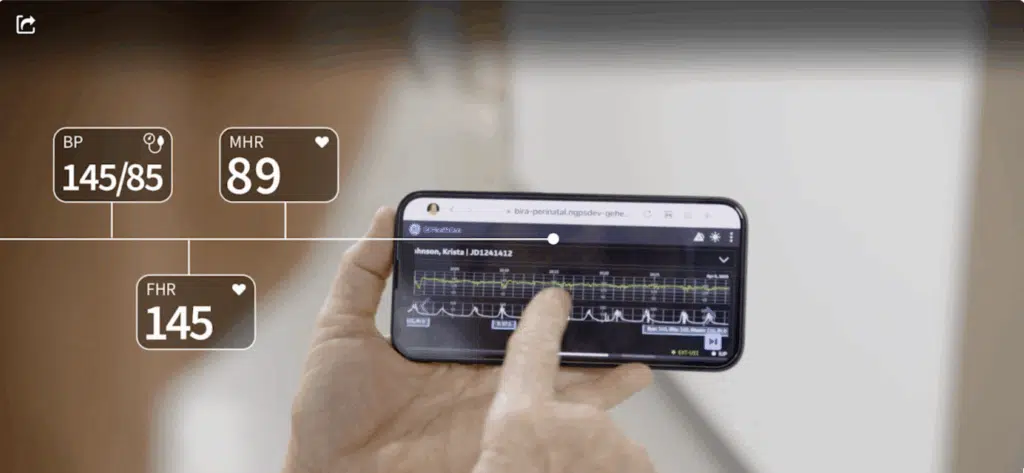
A screenshot of the video cited above displaying a simulation of patient data insights from the CareIntellect API dashboard. (Source: GE Healthcare)
The CareIntellect for Perinatal platform was officially announced in October 2025 as part of a joint public announcement by GE HealthCare and HCA Healthcare. Given the recent launch date, HCA Healthcare has not yet reported any measurable clinical or operational outcomes from the deployment of this AI-driven perinatal care solution.
However, a peer-reviewed narrative review conducted by Oxford University and published in Women’s Health details that AI and ML can use multimodal clinical data to predict:
- Preterm birth
- Birthweight
- Preeclampsia
- Mortality
- Hypertensive disorders, and
- Postpartum depression from multimodal clinical data.
Another scoping overview of research into AI in perinatal care from Nursing Reports found that AI-enabled remote monitoring platforms using wearable sensors for maternal vital signs have been linked to a 7–11% reduction in maternal mortality and preeclampsia. These systems enable early detection and timely clinician intervention, improving maternal safety during the perinatal period in pilot studies.
Source link
#Artificial #Intelligence #HCA #Healthcare #Cases