



















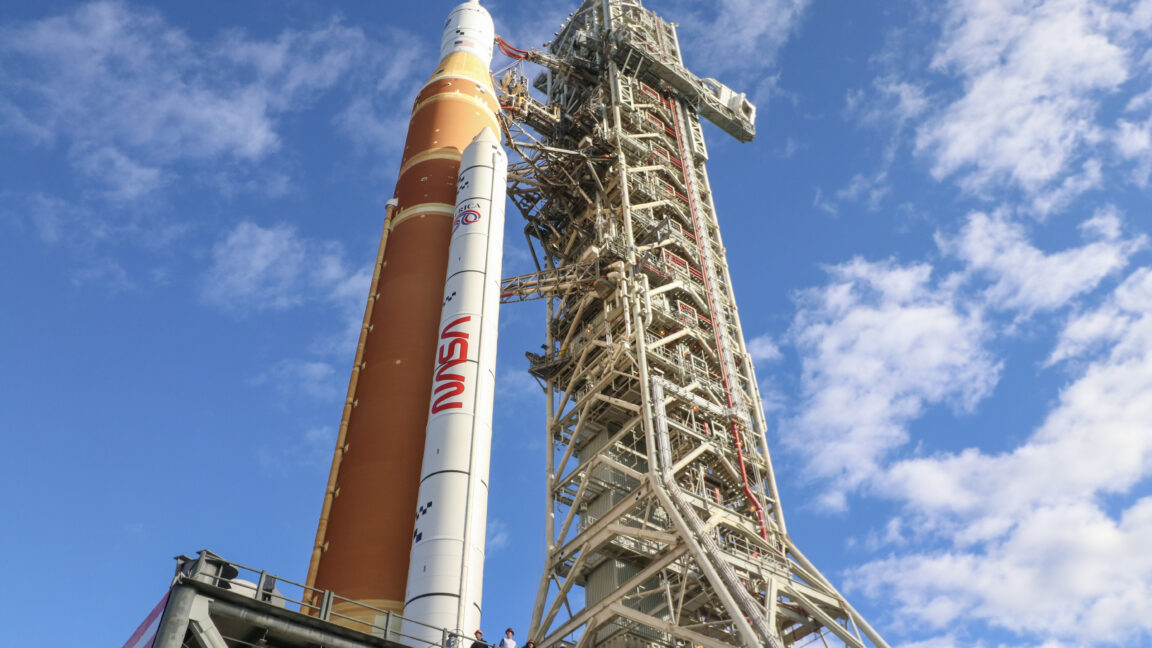

The launch team repaired a leaky hydrogen seal and introduced a gentler hydrogen loading procedure to overcome the problem. Hydrogen is an extremely efficient fuel for rockets, but its super-cold temperature and the tiny size of hydrogen molecules make it prone to leakage. The hydrogen feeds the SLS rocket’s four core stage engines and single upper stage engine.
“Artemis I was a test flight, and we learned a lot during that campaign getting to launch,” said Charlie Blackwell-Thompson, NASA’s Artemis II launch director. “The things that we’ve learned relative to how to go load this vehicle, how to load LOX (liquid oxygen), how to load hydrogen, have all been rolled in to the way in which we intend to load the Artemis II vehicle.”
NASA is hesitant to publicly set a target launch date until the agency gets through the dress rehearsal, but agency officials say a February launch remains feasible.
“We’ve held schedule pretty well getting to rollout today,” Isaacman said. “We have zero intention of communicating an actual launch date until we get through wet dress. But look, that’s our first window, and if everything is tracking accordingly, I know the teams are prepared, I know this crew is prepared, we’ll take it.”
“Wet dress is the driver to launch,” Blackwell-Thompson said. “With a wet dress that is without significant issues, if everything goes to plan, then certainly there are opportunities within February that could be achievable.”
One constraint that threw a wrench into NASA’s Artemis I launch campaign is no longer a significant factor for Artemis II. On Artemis I, NASA had to roll the rocket back to the Vehicle Assembly Building (VAB) after the wet dress rehearsal to complete final installation and testing on its flight termination system, which consists of a series of pyrotechnic charges designed to destroy the rocket if it flies off course and threatens populated areas after liftoff.
The US Space Force’s Eastern Range, responsible for public safety for all launches from Florida’s Space Coast, requires the flight termination system be retested after 28 to 35 days, a clock that started ticking last week before rollout. During Artemis I, technicians could not access the parts of the rocket they needed to in order to perform the retest at the launch pad. NASA now has structural arms to give ground teams the ability to reach parts higher up the rocket for the retest without returning to the hangar.
With this new capability, Artemis II could remain at the pad for launch opportunities in February and March before officials need to bring it back to the VAB to replace the flight termination system’s batteries, which still can’t be accessed at the pad.
Source link
#fastest #human #spaceflight #mission #history #crawls #closer #liftoff