



















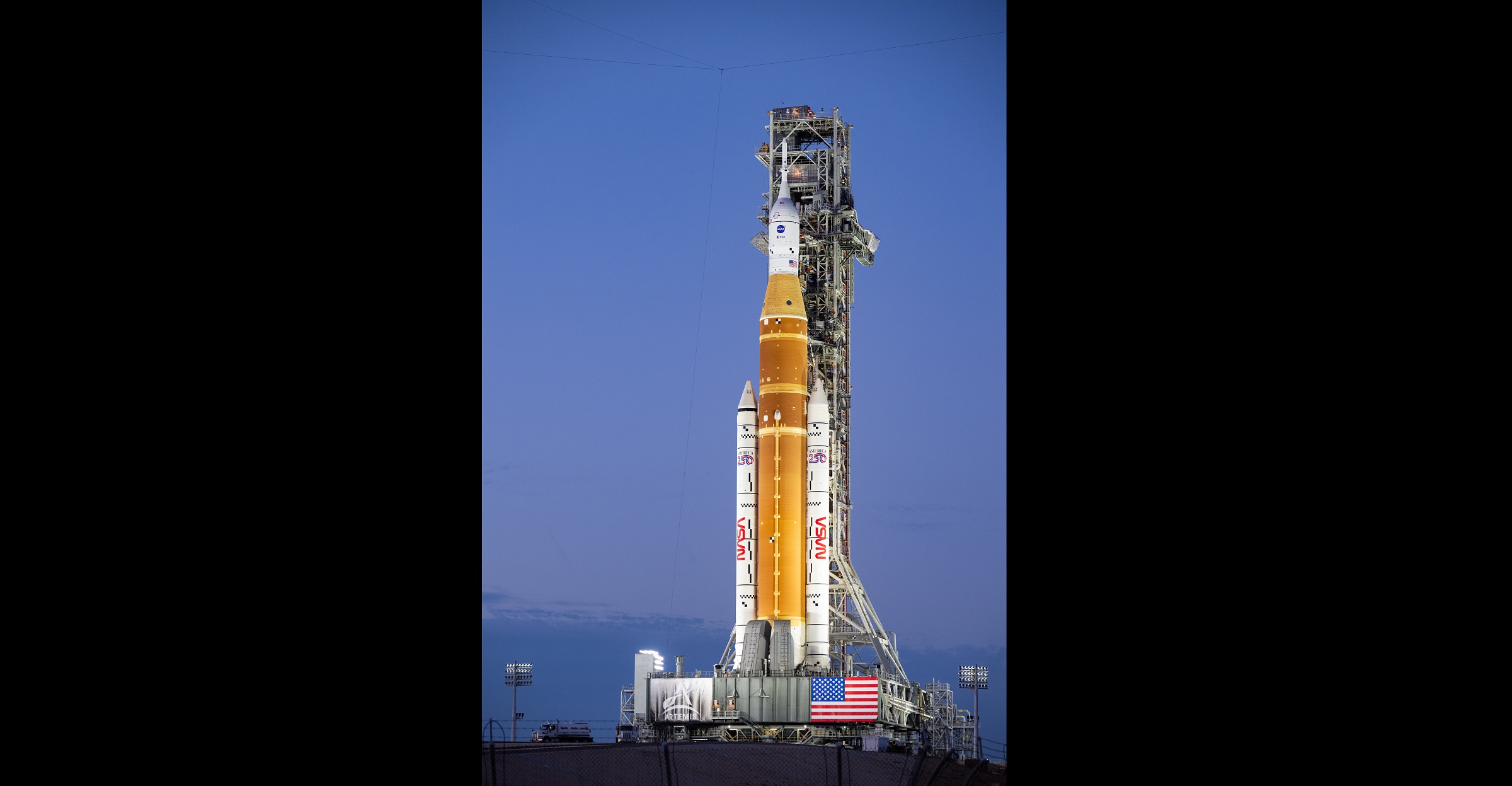

NASA’s Moon rocket has made it to its launchpad.
On Saturday, the towering assembly — comprising the enormous Space Launch System (SLS) rocket and a new Orion spacecraft — rode atop a behemoth moving platform called a crawler-transporter, inching its way at around one mile per hour from its Vehicle Assembly Building on one side of the Kennedy Space Center to its launchpad over four miles away. The trek lasted until nightfall, a small test of patience for what is a lunar mission years in the making: Artemis II.
“This is the start of a very long journey,” said Jared Isaacman, NASA’s new administrator, told reporters at the scene of the rocket’s launchpad journey, as quoted by The New York Times.
When — or if — the rocket launches, the ten-day Artemis II mission will see a crew of four astronauts visit the Moon for the first time in more than half a century. Or at least its orbital real estate: the astronauts won’t land on the lunar surface yet — that part comes in the following mission, Artemis III — but will instead closely fly around the rocky body before returning to Earth, a stunning achievement in its own right. One of the mission’s key objectives will be to test the spacecraft’s life support system, paving the way for an actual touchdown.
Still, there’s quite a bit of elbow grease ahead before NASA is even willing to announce a hard launch date. Now that the rocket’s on the pad, engineers will conduct what’s known as a wet dress rehearsal, loading its propellant tanks with over 700,000 gallons of super-chilled liquid propellant and running through a mock launch countdown, stopping short of actually igniting the SLS’s RS-25 engines. Afterwards, all of the propellant will be drained from the rocket, and from there, NASA will assess how the spacecraft performed. (It’s worth mentioning here that the previous Artemis I mission, the uncrewed dry-run for Artemis II, was delayed by the discovery of a leaky propellant seal.)
The earliest launch window is between February 6 and February 11. If that window is missed, then the next one to open up will be in March.
The commander of the mission is NASA astronaut Reid Wiseman, who will be joined by his colleagues Victor Glover and Christina Koch, as well as Canadian Space Agency astronaut Jeremy Hansen. Glover will be the first Black man to fly by the Moon, Koch the first woman, and Hansen the first non-American, the NYT noted. Altogether, the quartet will be the first people to fly to the Moon since Gene Cernan and Harrison Schmitt in the Apollo 17 mission in 1972.
The good feelings over Artemis II will at least temporarily subside questions over the fate of Artemis III — the mission that’s slated to see astronauts actually step on the lunar surface — which is looking dicey as there’s significant doubt over whether the spacecraft chosen to make the lunar landing, SpaceX’s Starship, will be ready in time.
More on NASA: Entire Space Station Down to Skeleton Crew After NASA Evacuation
Source link
#NASA #Moves #Giant #Artemis #Rocket #Launchpad #Blast #Astronauts #Moon