 Skip to content
AI companies are continuing to pour ungodly amounts of money into building out data centers, in an enormous bet that both analysts and tech leaders warn may not pay off for many years to come — if it ever does.
OpenAI most recently committed to spending well over a trillion dollars before the end of the decade as it continues to burn oodles of cash each quarter, enormous losses that are having investors asking some hard questions.
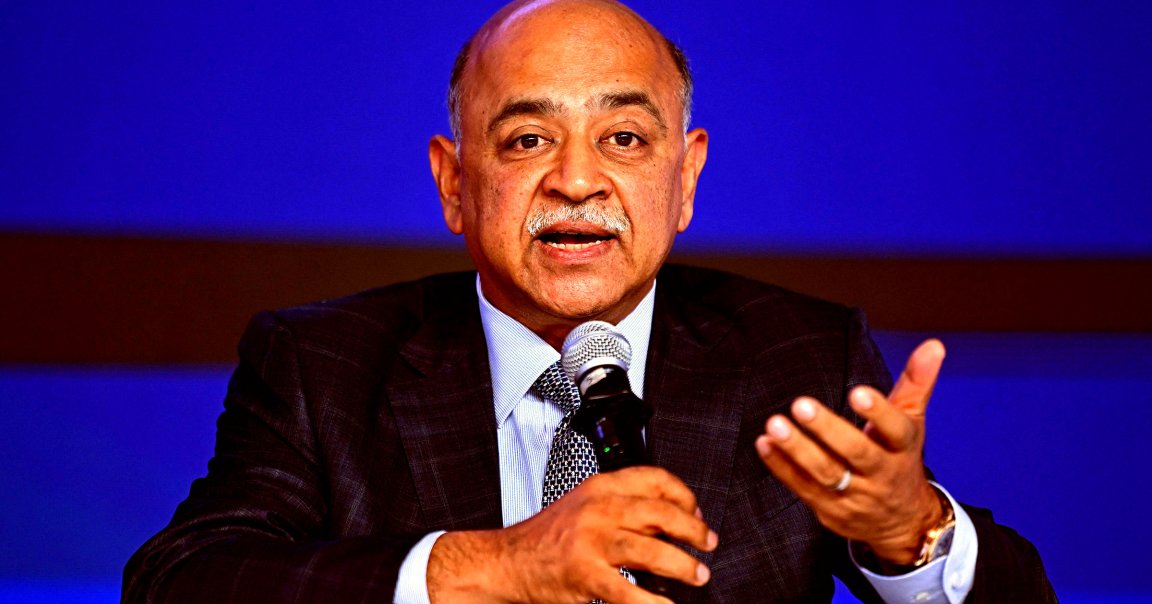
Put simply, as IBM CEO Arvind Krishna told The Verge‘s editor-in-chief Nilay Patel during a recent episode of the “Decoder” podcast, the math isn’t adding up.
When asked whether he thinks “there’s an enterprise [return on investment] that would justify the spend” on trying to achieve artificial general intelligence (AGI) — OpenAI’s ill-defined priority number one — Krishna laid out some back-of-the-envelope math.
“It takes about $80 billion to fill up a one-gigawatt data center,” he said. “That’s today’s number. If one company is going to commit 20-30 gigawatts, that’s $1.5 trillion of [capital expenditure].”
Considering the “total commits” of “chasing AGI” amounts to 100 gigawatts, he reasoned, that’s “$8 trillion of [capital expenditure].”
“It’s my view that there’s no way you’re going to get a return on that because $8 trillion of [capital expenditure] means you need roughly $800 billion of profit just to pay for the interest,” he concluded.
It’s a striking display of skepticism, highlighting a growing unease among executives that the enormous AI spending spree may not be sustainable, let alone rational, in the long run. AI companies’ valuations have soared to unprecedented levels, despite what the Wall Street Journal recently described as the lack of a “clear financial model for profitable AI.”
According to a recent analysis by investment bank HSBC, OpenAI won’t be making any profit for at least another four years, and will need to keep burning over $200 billion to keep up with its growth plans in terms of additional debt, equity — or new avenues of generating revenue, which is much easier said than done.
Interestingly, IBM is using the topic of an AI bubble as a litmus test for new hires. As Fortune reported this week, IBM executives are asking candidates whether they believe we’re in an AI bubble, a question that purportedly has no right or wrong answers.
“I strongly believe we aren’t, so let’s see what everyone else has to say,” IBM’s managing partner for Europe, the Middle East and Africa, told Fortune.
Besides some murky math, experts have long questioned Altman on his push to realize AGI, a term that remains nebulous at best, with OpenAI repeatedly being accused of shifting the goalposts to give the impression of progress.
Krishna described Altman’s drive to achieve AGI as chasing a “belief.”
“Nilay, I will be clear,” Krishna told Patel. “I am not convinced, or rather I give it really low odds — we’re talking like 0 to 1 percent — that the current set of known technologies gets us to AGI.”
Nonetheless, he believes that generative AI will be “incredibly useful for enterprise” and “unlock trillions of dollars of productivity.” However, getting to AGI will necessitate technological breakthroughs that will take us beyond large language models, Krishna argued.
“If we can figure out a way to fuse knowledge with LLMs,” we stand a chance of reaching AGI, he said. “Even then, I’m a maybe.”
More on the AI bubble: AI Investors Furious at Suggestion That There’s an AI Bubble
Source link
#IBM #CEO #Math #Doesnt #Add #Competitors #Spending


