




















Nine arms, no problem
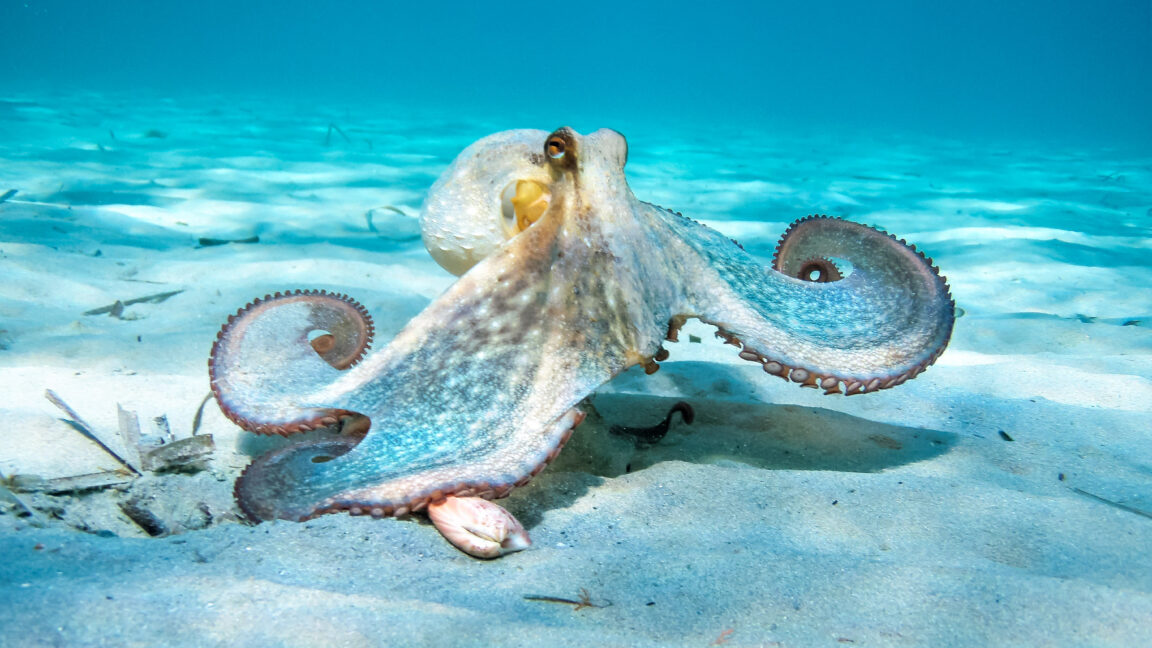
In 2021, researchers from the Institute of Marine Research in Spain used an underwater camera to follow a male Octopus vulgaris, or common octopus. On its left side, three arms were intact, while the others were reduced to uneven, stumpy lengths, sharply bitten off at varying points. Although the researchers didn’t witness the injury itself, they observed that the front right arm—known as R1—was regenerating unusually, splitting into two separate limbs and giving the octopus a total of nine arms.
“In this individual, we believe this condition was a result of abnormal regeneration [a genetic mutation] after an encounter with a predator,” explains Sam Soule, one of the researchers and the first author on the corresponding paper recently published in Animals.
The researchers named the octopus Salvador due to its bifurcated arm coiling up on itself like the two upturned ends of Salvador Dali’s moustache. For two years, the team studied the cephalopod’s behavior and found that it used its bifurcated arm less when doing “riskier” movements such as exploring or grabbing food, which would force the animal to stretch its arm out and expose it to further injury.
“One of the conclusions of our research is that the octopus likely retains a long-term memory of the original injury, as it tends to use the bifurcated arms for less risky tasks compared to the others,” elaborates Jorge Hernández Urcera, a lead author of the study. “This idea of lasting memory brought to mind Dalí’s famous painting The Persistence of Memory, which ultimately became the title of the paper we published on monitoring this particular octopus.”
While the octopus acted more protective of its extra limb, its nervous system had adapted to using the extra appendage, as the octopus was observed, after some time recovering from its injuries, using its ninth arm for probing its environment.
“That nine-armed octopus is a perfect example of just how adaptable these animals are,” Pelled adds. “Most animals would struggle with an unusual body part, but not the octopus. In this case, the octopus had a bifurcated (split) arm and still used it effectively, just like any other arm. That tells us the nervous system didn’t treat it as a mistake—it figured out how to make it work.”
Kenna Hughes-Castleberry is the science communicator at JILA (a joint physics research institute between the National Institute of Standards and Technology and the University of Colorado Boulder) and a freelance science journalist. Her main writing focuses are quantum physics, quantum technology, deep technology, social media, and the diversity of people in these fields, particularly women and people from minority ethnic and racial groups. Follow her on LinkedIn or visit her website.
Source link
#ninearmed #octopus #oddities #cephalopod #nervous #system